

How Much Does It Cost to Live in Batavia, IL?

What if you could enjoy historic Fox River charm and top-tier public schools without paying the Tri-Cities' steepest price tags? Moving west from Chicago or weighing adjacent Kane County communities can quickly feel daunting, especially when you're trying to decode Illinois property taxes and unpredictable monthly expenses. Batavia often flies under the radar, but evaluating the real cost of living in Batavia IL reveals why so many local buyers consider it the Fox Valley's smartest value anchor.
In this guide, you'll discover how Batavia pairs competitive home prices and city-owned utility savings with an enviable community lifestyle alongside Geneva and St. Charles. Here is a clear breakdown of 2026 housing numbers, local tax bills, and everyday costs so you can plan your suburban move with confidence.
Key Takeaways
- Learn how Batavia home prices compare to neighboring Geneva and St. Charles to help you secure the best real estate value in the Fox Valley.
- Discover the financial perks of Batavia's municipal electric utility and how it helps keep the overall cost of living in Batavia IL competitive.
- Understand how Kane County property tax assessments work so you can calculate an accurate, surprise-free monthly mortgage payment.
- Explore everyday dining, shopping, and recreation expenses, including free community perks along the Fox River and Quarry Beach.
Table of Contents
- Understanding Batavia IL Housing Market and Real Estate Value
- Evaluating Property Taxes and Essential Living Expenses in Kane County
- Lifestyle and Daily Costs: Living the Fox Valley Way
Understanding Batavia IL Housing Market and Real Estate Value
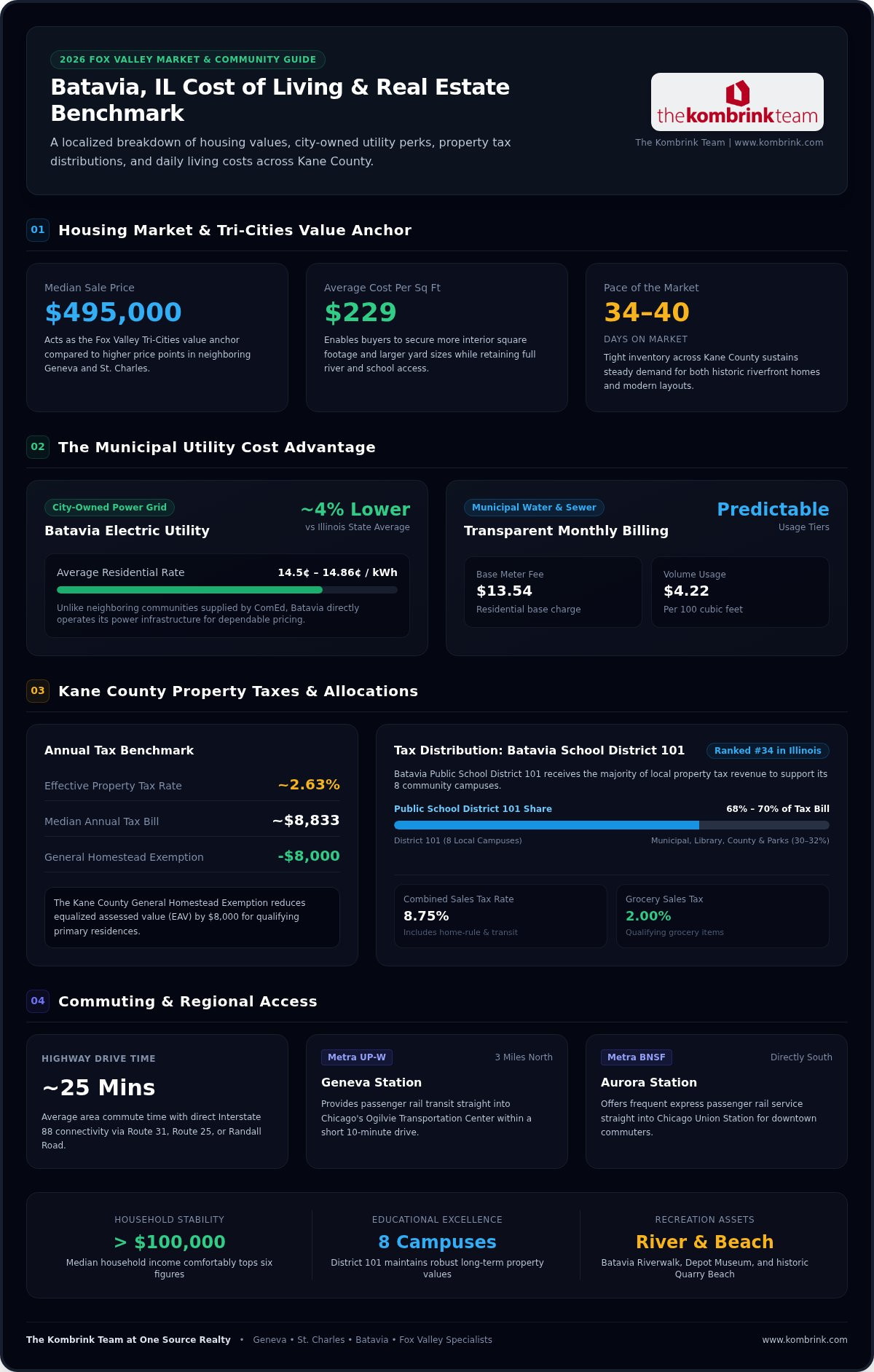
Housing represents the largest share of the cost of living in Batavia IL, yet it also provides the greatest financial value. Across Kane County, tight inventory has kept demand steady through 2026, with homes averaging just 34 to 40 days on the market. We often see buyers pleasantly surprised by the architectural variety available here. Whether you want a historic residence near the river or a modern layout west of Route 31, this Batavia, Illinois overview highlights how the city pairs quiet suburban neighborhoods with scenic Fox River history.
To see how these local housing dynamics play out on the ground, watch this helpful breakdown:

Batavia IL Inventory Is Up 37%... But Homes Are Still Selling Over Asking
What’s happening in the Batavia, Illinois real estate market right now? In August 2026: Median sold price: $460,000 Median days on market: 8 days Months of inventory: 1.4 Sold-to-list ratio: 100.3% Inventory: up 37% year over year Active listings: 45 Median price per square foot: $234 Even with more homes available, Batavia remains a competitive seller’s market. Properties are still moving quickly and selling slightly above asking price on average. Thinking about buying or selling a home in Batavia? Contact The Kombrink Team at One Source Realty at 630-402-0021.
Comparing Home Prices in Batavia vs Geneva and St. Charles
Within the Fox Valley Tri-Cities, an unmistakable pricing hierarchy exists. While neighboring Geneva and St. Charles often command higher price tags for comparable lot sizes, the Batavia housing market consistently acts as the region's value anchor. The median home sale price in Batavia sits around $495,000, averaging roughly $229 per square foot. That allows buyers to secure more square footage and larger yards without compromising on school quality or river access. You can view available properties directly on our Batavia real estate page to monitor current price points.

What $500K Buys in Geneva vs Batavia vs Elgin
What does a $500,000 home budget actually get you in Geneva, Batavia, or Elgin, Illinois? These three Fox Valley communities are close together, but your buying power can look very different. Geneva may mean trading some square footage for downtown charm and Metra access. Batavia can offer a balance of location, space, and amenities. In Elgin, $500K may stretch further with larger homes, newer construction, finished basements, and three-car garages. Of course, available homes change every week, and property taxes, HOA fees, updates, and maintenance all factor into the real cost of owning. Which would you choose for $500K: Geneva, Batavia, or Elgin?
If you had exactly five hundred thousand dollars to spend on a home, where would your money go furthest: Geneva, Batavia, or Elgin?
These Fox Valley towns are close enough that buyers often consider all three, but the same budget can create very different searches. Inventory changes weekly, so this is a general comparison.
Let’s start with Geneva. Around five hundred thousand dollars, buyers are often looking at three- or four-bedroom homes. You may find an older home with character, a traditional two-story, or a townhome with upscale finishes.
The main tradeoff is often space versus location. If you want to be close to downtown Geneva, Third Street, and the Metra station, you may get less square footage, a smaller yard, or a home that needs some updating. Farther from downtown, the same budget may open up more space and newer features.
Now let’s move to Batavia. At the same price, you can often find a similar bedroom count with a little more flexibility. Depending on the neighborhood, that might mean a larger yard, more living space, an updated kitchen, a finished basement, or a bigger garage.
Batavia can be a strong middle ground for buyers who want access to downtown, the Fox River, trails, and the Randall Road corridor. But updated homes in popular locations can still move quickly, so five hundred thousand dollars will not automatically check every box.
Then there’s Elgin. This is where the budget will often stretch the furthest, especially on the west side and in newer subdivisions. You may see four or even five bedrooms, more finished square footage, a three-car garage, a finished basement, or newer construction. Some communities also include pools, clubhouses, parks, and walking paths.
The tradeoff may be distance from a walkable downtown, a train station, or your preferred commute, depending on the neighborhood.
So, which town gives you the best value?
If downtown character and train access matter most, Geneva may be worth trading some space for location.
If you want a balance of location, community amenities, and living space, Batavia may hit the sweet spot.
If maximum square footage and newer features lead your list, Elgin may offer the strongest buying power.
Just remember that price is only part of the comparison. Property taxes, HOA fees, the age of major systems, and future maintenance all affect what a home really costs.
Which would you choose for five hundred thousand dollars: Geneva, Batavia, or Elgin? Tell me in the comments. For a real-time comparison of homes currently available, contact The Kombrink Team at 630-402-0021.
Evaluating Property Taxes and Essential Living Expenses in Kane County
Everyday essentials shape the true cost of living in Batavia IL just as much as list prices. One major advantage for residents is Batavia's municipal electric utility. Unlike surrounding communities that rely on ComEd, Batavia manages its own power grid, delivering average residential electricity rates around 14.5 to 14.86 cents per kWh. That sits roughly 4% below the Illinois average. City water and sewer billing also follow predictable municipal structures, with a base residential water meter fee of $13.54 and volume usage at $4.22 per 100 cubic feet.
According to U.S. Census Bureau Batavia housing data, local median household incomes comfortably top six figures, which helps balance baseline suburban living costs. Illinois primary homeowners can also trim their annual tax liability through Kane County's General Homestead Exemption, which lowers equalized assessed value by $8,000.
How Kane County Property Taxes Impact Your Monthly Budget
Property taxes in Batavia average an effective rate near 2.63%, resulting in a median annual bill of roughly $8,833. Batavia Public School District 101 receives the lion's share at around 68% to 70% of that total, funding eight community campuses. Because local tax card figures trail actual market changes, we recommend reviewing a customized home valuation report to see how current assessments directly influence carry costs. If you want help reviewing recent Kane County tax bills on a specific home, feel free to reach out to our local team for personalized guidance.
Lifestyle and Daily Costs: Living the Fox Valley Way
Daily routines in Batavia bring a refreshing balance to your wallet. Batavia's combined sales tax rate sits at 8.75%, which includes the municipal home-rule portion and regional transit funding, but qualifying groceries remain taxed at just 2.00%. Local dining and entertainment often cost less than comparable outings in Cook County or downtown Chicago. Residents also enjoy outstanding free recreation, from strolls around the Batavia Riverwalk and Depot Museum to swimming at the historic Quarry Beach facility. Strong public education through Batavia School District 101, which ranks #34 in Illinois, consistently preserves long-term home values.
For official community records and local services, you can consult Kane County government and property tax services directly. Exploring the day-to-day lifestyle shows how the total cost of living in Batavia IL rewards buyers looking for suburban stability.
Commuting Costs and Accessibility for Batavia Residents
Commuting options heavily influence family budgets. While Batavia does not house its own passenger rail depot, commuters enjoy two accessible Metra alternatives within a ten-minute drive:
- Geneva UP-W Station: Located three miles north, offering direct rail transit into Chicago's Ogilvie Transportation Center.
- Aurora BNSF Station: Located directly south, providing frequent express service into Chicago Union Station.
Drivers benefit from quick access to Interstate 88 via Route 31, Route 25, or Randall Road, keeping the average commute around 25 minutes. If you want to see how this connectivity stacks up against neighboring towns, check out our comprehensive St. Charles IL life guide for an adjacent community breakdown.
Making Batavia Your Next Fox Valley Home
Choosing your next community comes down to balancing lifestyle and long-term affordability. Batavia proves you don't have to compromise on historic riverfront charm or top-ranked schools to protect your family budget. From city-owned utility savings to approachable real estate prices compared to nearby towns, the cost of living in Batavia IL makes it an exceptional Fox Valley value. With over 30 years of local Fox Valley experience, The Kombrink Team helps buyers move forward with clarity by offering complimentary buyer consultations and tailored market reports.
Connect with The Kombrink Team for your personalized consultation Your ideal suburban home is well within reach, and having trusted local guides in your corner makes the entire journey smooth and rewarding.
Frequently Asked Questions
Is it cheaper to live in Batavia than Geneva?
Yes, living in Batavia is generally more affordable than living in Geneva. Batavia offers lower median home entry prices while sharing borders, river access, and comparable high-performing schools. While everyday shopping and grocery sales taxes are very similar across Kane County, Batavia buyers typically get more square footage per dollar, making the overall cost of living in Batavia IL more accessible.
What are the average utility costs in Batavia IL?
Average utility costs in Batavia trend lower than national averages, largely driven by city-managed electricity. The municipal electric rate averages around 14.5 to 14.86 cents per kWh with a $17.75 monthly customer charge. Water and sanitary sewer base fees add roughly $28 per month before metered usage charges, keeping total monthly utility overhead predictably competitive with surrounding Fox Valley suburbs.
Does Batavia have its own electric company?
Yes, Batavia operates its own municipal electric utility rather than relying on private investor-owned supply. The City of Batavia Public Works Electric Division manages distribution directly, bypassing standard ComEd supply delivery. This public structure keeps residential power rates about 4% below the Illinois statewide average, giving local homeowners stable electric service and shielded pricing that reduces total household expenses year-round.
How do property taxes in Batavia compare to St. Charles?
Property taxes in Batavia and St. Charles are relatively comparable, though subtle differences emerge based on school district levies. Batavia carries a median effective rate near 2.63%, with about 70% supporting District 101 schools. Because home assessments reflect purchase prices, Batavia's slightly lower median home valuations often produce smaller total tax bills in dollars than similar St. Charles homes, balancing the baseline cost of living in Batavia IL.
Disclaimer
This article is provided for general informational purposes only and is not intended as legal, tax, financial, or mortgage advice. Real estate laws, market conditions, rates, and individual circumstances can change. Consult the appropriate licensed professional regarding your specific situation.
Enjoy this blog post? Click here to subscribe for updates
Leave A Comment