

Illinois Home Seller Checklist: Steps From Prep to Closing
What if the biggest obstacle standing between you and a successful home sale isn't the market itself, but simply not knowing where to start? If that question resonates, you're far from alone. Selling a home in Illinois comes with its own set of moving parts, from understanding local market conditions to preparing your property for showings and navigating the paperwork that follows. Having a solid home seller checklist for Illinois in hand can make the difference between a stressful, drawn-out experience and a smooth, confident transition to your next chapter.
You already know that selling your home is one of the most significant financial decisions you'll make, and that feeling of wanting to get it right is completely valid. The good news is that with the right preparation and a clear roadmap, you can maximize your sale price and minimize your time on the market without the guesswork.
This guide walks you through every essential step of the Illinois home selling process, from your very first preparations to closing day, so you can move forward with clarity and confidence.
Key Takeaways
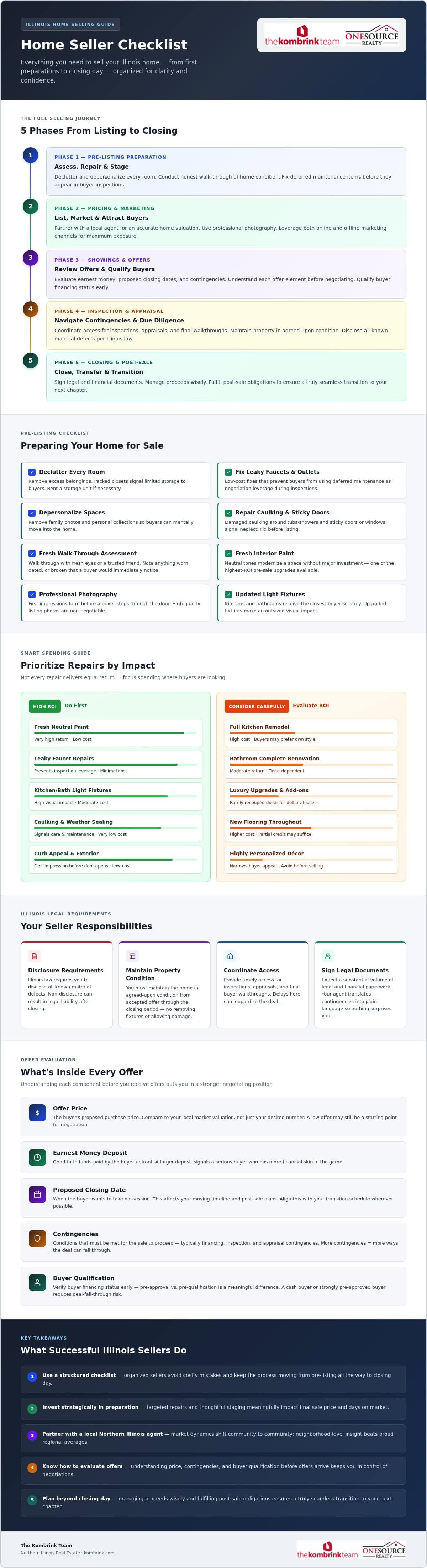
- Using a home seller checklist for Illinois keeps you organized through every stage of the process, from pre-listing preparations to closing day, so nothing slips through the cracks.
- Strategic home preparation, including targeted repairs and thoughtful staging, can meaningfully impact your final sale price and how quickly your listing attracts serious buyers.
- Partnering with the right local real estate agent and leveraging both online and offline marketing channels gives your home the broadest possible exposure in the Northern Illinois market.
- Understanding how to evaluate offers, qualify buyers, and navigate counteroffers puts you in a stronger negotiating position and helps protect your bottom line.
- Your responsibilities don't end at the closing table, and knowing what comes next, from managing your proceeds to fulfilling post-sale obligations, ensures a truly seamless transition.
Table of Contents
- Understanding the Home Selling Process in Illinois
- Preparing Your Home for Sale: A Step-by-Step Checklist
- Listing Your Home: Marketing Strategies for Success
- Negotiating Offers and Closing the Sale
- Post-Sale: What Happens After Closing?
Understanding the Home Selling Process in Illinois
Selling a home in Illinois isn't a single event. It's a sequence of interconnected decisions, each one building on the last. Before you place that "For Sale" sign in the yard, it helps to understand the full arc of the journey ahead, because sellers who know what's coming are far better positioned to respond confidently when challenges arise.
Key Steps in Selling Your Home
Every successful sale starts well before your listing goes live. The foundational work, assessing your home's condition, understanding your local market, and clarifying your financial goals, shapes every decision that follows. In Northern Illinois, market dynamics can shift noticeably from one community to the next, which is why a one-size-fits-all approach rarely serves sellers well. A seasoned local agent can provide a home valuation report that reflects genuine neighborhood-level insight rather than broad regional averages.
As a seller, your responsibilities extend beyond simply accepting an offer. You'll need to:
- Disclose known material defects in accordance with Illinois disclosure requirements
- Maintain the property in agreed-upon condition through the closing period
- Coordinate access for inspections, appraisals, and final walkthroughs
- Review and sign a substantial volume of legal and financial documents
What to Expect During the Selling Journey
From the day your home is listed to the moment you hand over the keys, the typical Illinois sale moves through several distinct phases. Listing preparation and photography, active showings, offer review, inspection negotiations, appraisal, and final closing each carry their own timelines and pressure points. While timelines vary depending on market conditions and buyer financing, sellers should generally plan for a process that spans several weeks from listing to closing.
Communication is the thread that holds it all together. Your agent should keep you informed at every milestone, translating complex contingencies into plain language and flagging anything that requires your prompt attention. When offers arrive, they'll typically come with an earnest money deposit, a proposed closing date, and a set of contingencies. Understanding what each element means before you're sitting across from an offer is where a solid home seller checklist for Illinois proves its value.
The Kombrink Team's deep roots in the Northern Illinois market mean that clients aren't navigating these stages alone. That kind of personalized, locally grounded support is exactly what transforms a complex process into a manageable one. Working through your home seller checklist Illinois step by step, with an experienced partner beside you, keeps the process moving without the guesswork.
Preparing Your Home for Sale: A Step-by-Step Checklist
First impressions form fast, and in real estate, they form before a buyer even steps through the door. The preparation work you do in the weeks leading up to your listing is where much of your sale price is actually won or lost. A thorough home seller checklist Illinois treats this stage not as optional polish, but as foundational strategy.
Start with decluttering and depersonalizing every room. This isn't about erasing your personality; it's about helping buyers mentally move in. Packed closets signal limited storage. Family photos and personal collections, however cherished, pull a buyer's attention away from the home itself. Box up what you don't need daily and rent a storage unit if necessary. The goal is open, breathable space that feels full of possibility.
Depersonalizing goes hand in hand with a honest self-assessment of your home's condition. Walk through each room with fresh eyes, or better yet, ask a trusted friend to do it with you. Note anything that looks worn, dated, or broken. Small issues that feel invisible to you after years of living there can register immediately to a buyer.
Necessary Repairs and Improvements
Not every repair delivers equal return, so prioritize strategically. Focus first on items that will surface during a buyer's inspection anyway: leaky faucets, faulty outlets, damaged caulking around tubs and showers, and sticky doors or windows. These are low-cost fixes that prevent buyers from using deferred maintenance as leverage in negotiations.
Cost-effective upgrades worth considering include:
- Fresh interior paint in neutral tones, which modernizes a space without a major investment
- Updated light fixtures in kitchens and bathrooms, where buyers tend to look closely
- Landscaping touch-ups, including fresh mulch and trimmed shrubs, to strengthen curb appeal immediately
- Deep cleaning of carpets, grout, and appliances, because cleanliness signals care
For anything structural, electrical, or involving the roof, consult a licensed professional before listing. Attempting significant repairs without proper expertise can create disclosure complications down the line.
Home Staging Tips
Staging is about editing, not decorating. Remove excess furniture to make rooms feel larger, and arrange what remains to highlight natural light and traffic flow. In Northern Illinois, where buyers often view homes during colder months, a warm, well-lit interior can be a genuine differentiator. Avoid the common mistake of over-staging with trendy pieces that distract rather than complement the home's architecture.
One step many sellers overlook is scheduling a pre-listing home inspection. Knowing what an inspector will find before buyers do gives you the opportunity to address issues on your terms rather than theirs. Pair that with a professional home valuation report to set an asking price grounded in real market data, not wishful thinking. Pricing accurately from day one attracts serious buyers and reduces the risk of your listing going stale.
Taken together, these preparation steps are the backbone of a complete home seller checklist for Illinois sellers who want to compete confidently in their local market.
Listing Your Home: Marketing Strategies for Success
Preparation gets your home ready. Marketing gets it sold. Even the most beautifully staged property can sit unseen without a deliberate strategy to put it in front of the right buyers at the right moment. This is where choosing the right real estate agent becomes one of the most consequential decisions in your entire home seller checklist Illinois journey.
Look beyond commission rates when evaluating agents. Ask specifically about their marketing plan, their familiarity with your neighborhood's buyer profile, and how they use local market data to position listings competitively. An agent with genuine roots in Northern Illinois brings something no algorithm can replicate: nuanced, community-level insight into what buyers in your area are actually searching for.
A well-rounded marketing approach combines digital reach with local presence. Online, your listing should appear across major real estate platforms, be optimized for search visibility, and include social media promotion targeting buyers actively browsing in your price range and zip code. Offline, yard signage, neighborhood flyers, and agent-to-agent networking still generate meaningful buyer traffic, particularly in tighter-knit Illinois communities where word travels fast.
Open houses and private showings each serve a distinct purpose. Open houses create urgency and allow multiple buyers to experience the home simultaneously, which can accelerate offer timelines. Private showings tend to attract more serious, pre-qualified buyers. A strategic agent will schedule both thoughtfully, timing open houses around local market activity and ensuring your home is consistently accessible without disrupting your daily life more than necessary.
The Role of Professional Photography
Buyers form their first impression of your home through a screen, often before they've read a single word of the listing description. Professional photography isn't a luxury; it's the foundation of your entire online presence. Well-composed, properly lit images showcase space, light, and detail in ways smartphone photos simply can't replicate. Before the photographer arrives, ensure every room reflects the decluttered, staged condition you've already worked to achieve. Virtual tours add another layer of accessibility, allowing out-of-area buyers or those with busy schedules to explore your home in depth before committing to an in-person visit.
Creating Compelling Listing Descriptions
A strong listing description does two things simultaneously: it highlights your home's most distinctive features and speaks directly to the lifestyle a buyer is seeking. Lead with your most compelling selling points, whether that's a recently updated kitchen, a generous lot, or proximity to highly regarded local schools. Be specific rather than generic. "Bright, open-plan living area with south-facing windows" communicates far more than "nice layout." Avoid overused superlatives that buyers have learned to tune out, and never misrepresent a feature, since accuracy builds trust and prevents complications later in the process.
Taken together, a strong agent partnership, multi-channel marketing, and polished presentation form the promotional backbone of any complete home seller checklist for Illinois sellers serious about maximizing their results.
Negotiating Offers and Closing the Sale
An offer landing in your inbox is an exciting moment, but it's also the point where clear thinking matters most. The number on the page is just the beginning. Every element of that offer, from contingencies to closing timelines, shapes the actual value you'll walk away with. A complete home seller checklist Illinois treats offer evaluation as a structured process, not a gut reaction.
Evaluating Offers: What to Look For
Price matters, but it's rarely the whole story. When reviewing an offer, look closely at these factors together:
- Financing type: Cash offers eliminate appraisal and lender-related delays. Conventional financing is generally more reliable than government-backed loans when timelines are tight.
- Contingencies: Inspection, appraisal, and financing contingencies all give buyers exit ramps. Fewer contingencies typically mean less risk for you, though they're also standard and expected in most Illinois transactions.
- Earnest money deposit: A larger deposit signals a committed buyer. A low deposit relative to the purchase price can be a red flag worth discussing with your agent.
- Proposed closing date: Does it align with your timeline? A buyer offering a higher price but requesting a closing date that doesn't work for you may be less valuable than a slightly lower offer with a timeline that fits.
Counteroffers are a normal, healthy part of the process. Don't interpret a buyer's first offer as their final position. Your agent can help you craft a counteroffer that moves toward your goals without unnecessarily cooling a buyer's interest. Sometimes the right move is accepting quickly; sometimes it's holding firm. Local market conditions in Northern Illinois should inform that judgment every time.
Closing Costs and Responsibilities
Illinois sellers typically carry a meaningful share of closing costs. These commonly include the real estate agent's commission, transfer taxes, title insurance fees, and any agreed-upon seller concessions. Attorney fees are also standard in Illinois, where real estate attorneys play a direct role in the closing process rather than the optional advisory role they serve in some other states.
Before closing day, you'll need to complete any repairs agreed upon during inspection negotiations, maintain the home in its contracted condition, and ensure utilities remain active for the buyer's final walkthrough. That walkthrough, typically scheduled within 24 hours of closing, gives the buyer an opportunity to confirm nothing has changed since their last visit. Surprises at this stage can delay closing, so proactive communication with your agent throughout the final weeks is essential.
On closing day itself, you'll sign the deed and transfer documents, receive your net proceeds after outstanding mortgage balances and closing costs are settled, and hand over the keys. It's a well-choreographed process when everyone comes prepared.
Having an experienced local partner guiding you through offer evaluation and the closing sequence makes a genuine difference. Connect with the Kombrink Team to work with agents who know the Northern Illinois market and will advocate for your best outcome from first offer to final signature.
Post-Sale: What Happens After Closing?
Closing day feels like the finish line, but it's more accurately the start of a new chapter. Once the documents are signed and the keys are handed over, a handful of important responsibilities remain. Sellers who treat closing as a hard stop sometimes find themselves caught off guard by what comes next. A thorough home seller checklist Illinois accounts for the post-sale period just as carefully as everything that came before it.
Final Tasks After Selling Your Home
Your first priority after closing is getting your financial house in order. If you carried a mortgage, confirm that it's been fully paid off and request written confirmation from your lender. Keep a complete file of your closing documents, including the settlement statement, deed transfer paperwork, and any repair receipts from the sale process. These records matter come tax season and can be essential if any questions arise about the transaction later.
On the tax side, Illinois sellers may be subject to capital gains considerations depending on how long they owned the property and how it was used. Speak with a tax professional promptly after closing rather than waiting until the following spring. Acting early gives you more options and fewer surprises.
Before you fully move on, make sure you've fulfilled every post-closing obligation outlined in your purchase agreement. That might include leaving behind specific appliances, completing a repair that was part of your negotiated terms, or transferring utility accounts on the agreed date. Small loose ends left unresolved can create friction with the buyer even after the sale is complete.
With your proceeds in hand, resist the urge to make major financial decisions immediately. Whether you're rolling equity into a new purchase, investing, or paying down debt, give yourself a brief window to consult with a financial advisor before committing to anything significant.
Staying Connected with Your Agent
The relationship you've built with your agent doesn't have to end at closing. A trusted local agent remains a valuable resource long after the transaction is complete. They can help you understand your new neighborhood's market if you're buying nearby, connect you with reliable local professionals for your next home, and keep you informed about Northern Illinois market conditions that might affect future decisions.
When you're ready to buy again, or when someone in your circle is thinking about selling, that existing relationship means you're not starting from scratch. The Kombrink Team's commitment to personalized service extends well beyond any single transaction. Reach out to the Kombrink Team whenever your next real estate need arises, because having a familiar, knowledgeable partner in your corner is always worth more than starting over with someone new.
Your Next Move Starts Here
Selling a home in Illinois is a significant undertaking, but it doesn't have to feel overwhelming. When you work through a complete home seller checklist Illinois sellers can rely on, the process becomes a series of manageable steps rather than one daunting leap. Prepare your home thoughtfully, market it strategically, negotiate from a position of knowledge, and handle your post-sale responsibilities with the same care you brought to everything before them.
What makes the difference between a stressful experience and a confident one often comes down to who's in your corner. The Kombrink Team is a family-owned real estate team with a proven track record and deep roots in the Northern Illinois market. Their personalized approach means you're never just another transaction; you're a neighbor making one of the most important decisions of your life, and that deserves real, attentive guidance.
You've done the research. Now take the next step. Get your personalized home selling strategy today! and move forward with a team that genuinely knows your market.
Frequently Asked Questions About Selling a Home in Illinois
What should I do first when preparing to sell my home?
Start by getting a professional home valuation report so you understand where your property stands in the current market. This single step informs nearly every decision that follows, from how much to invest in repairs to how to price your listing competitively. Once you have a realistic picture of your home's market value, you can build a preparation plan that's grounded in data rather than guesswork.
From there, walk through your home with fresh eyes and create a prioritized list of repairs, cleaning tasks, and decluttering projects. Tackling the foundational work before your listing goes live gives you control over the process rather than reacting to buyer feedback after the fact.
How long does it typically take to sell a home in Illinois?
The timeline varies based on local market conditions, your price point, and how well the home is prepared and marketed. In active Northern Illinois markets, well-priced, move-in-ready homes can attract offers within days of listing. In slower conditions or at higher price points, the process may stretch to several weeks or longer before the right buyer arrives.
Beyond receiving an offer, plan for additional time to move through inspection negotiations, appraisal, and lender approval before reaching closing. Sellers who account for this full timeline from the start tend to experience far less stress along the way.
What are the common closing costs for sellers?
Illinois sellers typically pay real estate agent commissions, state and county transfer taxes, title insurance fees, and attorney fees. Illinois is an attorney-review state, meaning legal representation at closing isn't optional; it's a standard part of the process. You may also be responsible for any seller concessions negotiated during the offer process, such as contributing toward the buyer's closing costs.
The exact amount you'll owe depends on your sale price, your mortgage payoff balance, and what's been agreed upon in your contract. Your agent can provide a seller's net sheet early in the process so you're never caught off guard by the numbers on closing day.
How can I make my home stand out to buyers?
Accurate pricing is the single most powerful tool in your arsenal. A home priced correctly from day one attracts serious buyers quickly and avoids the stigma that comes with repeated price reductions. Pair that with professional photography, a well-written listing description, and a clean, staged interior, and your home will make a strong impression both online and in person.
Small details matter more than sellers often expect. Consistent cleanliness during the showing period, a welcoming exterior, and prompt responses to showing requests all signal to buyers that the home has been well cared for, which builds confidence and supports stronger offers.
What paperwork is required to sell my home in Illinois?
Illinois sellers are required to complete a Residential Real Property Disclosure Report, which documents known material defects in the property. You'll also sign the purchase agreement, any addenda or amendment documents, and the closing deed transfer paperwork. If the property is in a homeowners association, HOA disclosure documents are typically required as well.
Because Illinois real estate transactions involve attorney review, your closing attorney will prepare and walk you through the legal documents specific to your sale. Keeping organized records of your mortgage statements, repair receipts, and prior inspection reports from when you purchased the home can also streamline the process considerably.
What if my home doesn't sell right away?
A listing that sits without offers is usually sending a signal worth listening to. The most common culprits are pricing that doesn't align with current market conditions, presentation issues that can be addressed with staging or repairs, or insufficient marketing reach. Rather than waiting and hoping, treat a slow start as useful feedback and work with your agent to identify which factor is most likely at play.
Using your home seller checklist Illinois as a reference point can help you audit each stage of the process systematically. Sometimes a modest price adjustment is all it takes. Other times, refreshed photography or a revised listing description makes the difference. A locally experienced agent can help you diagnose the issue and respond with a targeted strategy rather than a reactive one.
Can I sell my home without a real estate agent?
Selling without an agent, often called a For Sale By Owner transaction, is legally permitted in Illinois. However, it places the full burden of pricing, marketing, negotiation, disclosure compliance, and closing coordination on your shoulders. Sellers who go this route sometimes underestimate how much specialized knowledge and local market insight an experienced agent brings to each of those stages.
For most sellers, the value a skilled agent delivers in negotiating a stronger sale price and navigating Illinois-specific legal requirements outweighs the cost of their commission. If you're weighing the decision, it's worth having an honest conversation with a local agent first so you can make a fully informed choice rather than one based on assumptions about what the process involves.
Posted by The Kombrink Team onEnjoy this blog post? Click here to subscribe for updates
Leave A Comment