

How Mortgage Rates Affect Home Prices in the Fox Valley

A mortgage-rate change can affect what buyers can afford more directly than what a home is worth. That distinction helps explain how interest rates affect home prices: higher borrowing costs can narrow buyers’ budgets and influence demand, but rates don’t set a home’s price on their own. Local inventory, comparable sales, and the property itself still matter.
If you’re considering a move in Geneva, St. Charles, Batavia, or elsewhere in the Fox Valley, national headlines are only part of the picture. Buyers looking in Geneva may face different options and competition than those searching in Aurora, Elgin, or Sugar Grove. This guide explains how borrowing costs can shape buyer activity and how to weigh rate changes against conditions in the community and price range you’re considering, without relying on a rate forecast to make your decision.
Key Takeaways
- Understand how interest rates affect home prices by influencing buyer budgets and demand, without assuming rates alone determine a home’s value.
- When rates rise, hold steady, or fall, compare possible buyer responses with current conditions in the specific Fox Valley community you’re considering.
- Use local inventory, comparable sales, and property-specific details to put national rate news in context for Geneva, St. Charles, Batavia, and nearby areas.
- Before deciding to buy or sell, weigh your goals, timing, and housing needs against current local evidence. Waiting for rates to change doesn’t guarantee a better outcome.
Table of Contents
- How interest rates affect home prices through affordability and demand
- How to read interest-rate changes in Geneva and the Fox Valley
- How buyers and sellers can make decisions without trying to time rates
How interest rates affect home prices through affordability and demand
How interest rates affect home prices starts with the cost of borrowing. A mortgage interest rate is the cost a borrower pays to use a lender’s money. When rates rise, the same loan amount generally comes with a higher monthly principal-and-interest payment. Some buyers may respond by looking at lower-priced homes, changing their search area, or pausing their plans. If enough buyers pull back, demand may ease and put pressure on prices.
That effect isn’t automatic. If the number of homes for sale is limited, competition for available properties may continue even as borrowing costs rise. A home’s value also depends on its location, condition, features, and recent comparable sales, not just the prevailing rate. For a Geneva home, nearby sales of similar properties can offer more useful context than a national headline. See our Geneva real estate information for a local starting point.
Why a rate change can alter what buyers can afford
For a buyer considering the same home price, a change in borrowing costs can change the potential monthly payment . That may affect which homes fit the buyer’s budget and how many buyers are ready to compete for a property. The effect varies with the buyer’s circumstances, loan terms, available homes, and market conditions, so this general relationship isn’t a personal affordability calculation.
In Geneva and across the Fox Valley, compare rate news with local inventory and sales of similar homes. Look at the property type, size, condition, and timing of comparable sales rather than relying on a single broad average. That’s one reason higher mortgage rates can sometimes affect housing supply in unexpected ways .
How to read interest-rate changes in Geneva and the Fox Valley
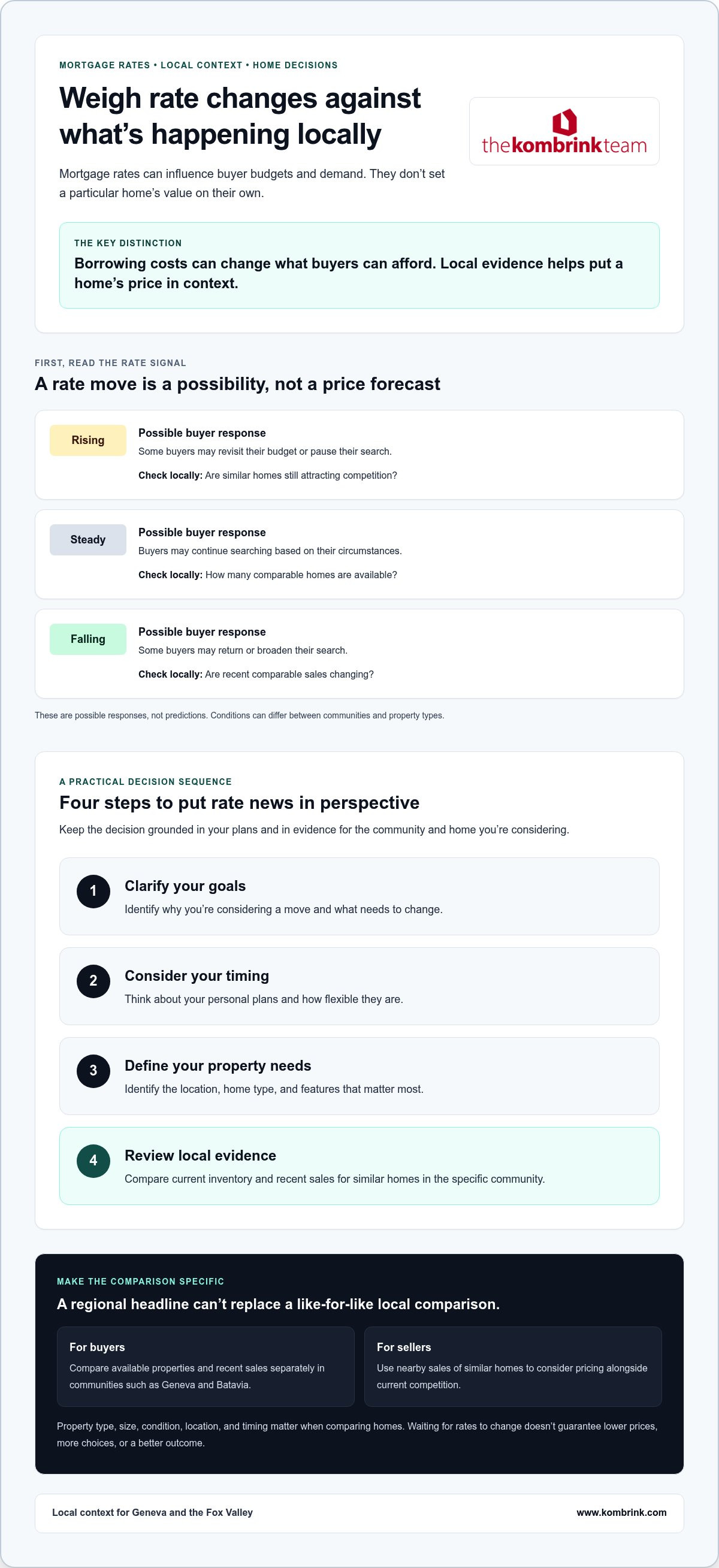
A rate headline is a starting point, not a local price forecast. To understand how interest rates affect home prices, compare rate news with current inventory, recent comparable sales, and the features of homes in the community you’re considering. Check that the homes you’re comparing are similar and that the reports cover the same time period.
| Rate movement | Possible buyer response | Local context to check |
|---|---|---|
| Rising | Some buyers may revisit their budget or pause their search. | Are similar homes still attracting competition? |
| Steady | Buyers may continue searching based on their circumstances. | How many comparable homes are available? |
| Falling | Some buyers may return or broaden their search. | Are recent comparable sales changing? |
These are possibilities, not predictions. The same rate movement can meet different conditions across Geneva, Batavia, St. Charles, South Elgin, North Aurora, Sugar Grove, Elburn, West Chicago, Wheaton, Naperville, Aurora, Elgin, Bartlett, Bloomingdale, Campton Hills, Carol Stream, and DeKalb, as well as Kane and DuPage counties. Compare homes with similar property types and features rather than assuming one city’s activity represents the whole area.
Why national headlines do not predict Geneva home prices
Local supply, buyer interest, and property details shape results. A home’s condition, layout, location, and the number of comparable options can all influence how buyers assess it. Explore Geneva real estate information for community context, then review current evidence for the property you’re considering.
For broader context, see Chicagoland mortgage interest rates and the Fox Valley housing market forecast. Use them as background, not as a substitute for current local comparisons. A regional report may combine communities with different housing options, so check which places and property types it covers.
How buyers and sellers can make decisions without trying to time rates
Rate forecasts can’t tell you exactly what home prices will do next. Waiting for rates to change doesn’t guarantee lower prices, more choices, or a better outcome. Rather than making a move hinge on one forecast, review the decision in a practical order:
- Goals: Clarify why you’re considering a move and what needs to change.
- Timing: Consider your personal plans and how flexible they are.
- Property needs: Identify the location, home type, and features that matter most.
- Local evidence: Review current inventory and comparable sales for the specific community and property.
For example, a buyer comparing homes in Geneva and Batavia can look separately at the available properties and recent sales in each community, rather than assuming a regional rate headline affects both markets in the same way. A seller can use nearby sales of similar homes to evaluate pricing in the context of current competition. This puts how interest rates affect home prices in perspective: a rate change may influence buyer activity, but it doesn’t settle what a particular home is worth or whether a move fits your circumstances. For broader Illinois context, read our Illinois home-price analysis .
What local guidance can clarify before your next move
If you’re selling, a current home valuation and local market report can help establish a starting point by relating your property to recent comparable sales and current conditions. The Kombrink Team provides free home valuations and real estate market reports for homeowners considering a sale. If you’re buying, a [complimentary consultation](https://- https://www.kombrink.com/buyer/) and local market context can help focus your search without trying to predict the next rate move. These resources offer perspective, not guarantees.
If you’re weighing a move in Geneva or the Fox Valley, talk with The Kombrink Team about your local market questions.
Make Your Next Move With Local Context
Mortgage rates can influence buyer budgets and demand, but they don’t set every home’s value. Understanding how interest rates affect home prices means looking beyond national headlines to Geneva and Fox Valley inventory, comparable sales, and the details of each property. Waiting for rates to move doesn’t guarantee a lower price or a better outcome, so weigh current local evidence alongside your goals and timing.
The Kombrink Team has served Northern Illinois since 1991. Sellers can use a free home valuation to get a clearer starting point, while buyers can discuss their search in a complimentary consultation. With residential buying and selling services across the Fox Valley and greater Northern Illinois, the team can help you put local market information in context.
Request a free home appraisal or complimentary buyer consultation A well-informed decision starts with the market in front of you and the move that fits your plans.
Frequently Asked Questions
Do home prices always fall when interest rates rise?
No. For a useful comparison, separate asking prices from completed sale prices and compare similar homes over a consistent period. A listing shows what a seller hopes to receive, while a closed sale shows what a buyer agreed to pay. Differences in condition, size, and property type can make a broad market average less useful for evaluating one home.
Can lower mortgage rates make home prices go up?
They can bring more buyers into a search, but a change in buyer interest doesn’t tell you what will happen to a particular listing. Watch whether the number of homes available changes too, and whether comparable properties are receiving offers or closing at different prices. Those details help distinguish increased attention from a lasting shift in sale prices.
How do interest rates affect home prices in Geneva and the Fox Valley?
Start by checking how each market report defines “Fox Valley,” since geographic boundaries can differ. Also check the report’s timeframe, property types, and whether it tracks listing or sale prices. For a Geneva home, compare Geneva properties with similar characteristics rather than relying on a regional figure that may combine different communities and housing options.
Should I wait for interest rates to drop before buying or selling?
There’s no universal answer. Buyers can clarify which property features and locations are essential, while sellers can consider their intended timing and next housing needs. Then review relevant local sales and available homes. If a decision depends on mortgage costs or loan terms, discuss those financial questions with a qualified mortgage professional rather than relying on a market forecast.
Disclaimer
This article is provided for general informational purposes only and is not intended as legal, tax, financial, or mortgage advice. Real estate laws, market conditions, rates, and individual circumstances can change. Consult the appropriate licensed professional regarding your specific situation.
Enjoy this blog post? Click here to subscribe for updates
Leave A Comment