

Kane County vs. DuPage County Real Estate: How to Compare Your Options

Are you weighing a home in Kane County against one in DuPage County? The answer isn’t simply a matter of choosing the county with the more appealing headline numbers. In a Kane county vs DuPage county real estate comparison, taxes and market figures are useful context, but they don’t tell the whole story of a particular property or community.
For 2026, start with current information and homes you’d genuinely consider. A search that includes Aurora, Elgin, South Elgin, North Aurora, Sugar Grove, or Elburn may bring different options into view than one centered on Geneva, Naperville, or Wheaton. Compare the towns, property types, and day-to-day priorities that matter to you, rather than relying on county averages alone.
Key Takeaways
- Kane county vs DuPage county real estate is best compared by specific towns and homes, not county labels alone.
- Match your search to the home type, location, and commute that suit your plans.
- Use current, like-for-like listing information when weighing prices, inventory, and time on market.
- Start with your priorities, shortlist communities, then compare homes that meet your needs.
Table of Contents
- Kane County vs. DuPage County real estate: why town-level comparisons matter
- How to compare Kane and DuPage County homes for your priorities
- Choose a county by narrowing your search to the right local fit
Kane County vs. DuPage County real estate: why town-level comparisons matter
Neither county is automatically the better choice for every buyer or seller. Kane county vs DuPage county real estate is a useful starting point, but a county-wide label can hide meaningful differences between municipalities, neighborhoods, and the homes available in them.
County boundaries provide context, but they don’t tell you whether a particular home suits your budget, preferred property type, commute, or plans. Compare specific towns and homes, then look at the details of each property. That approach gives you a more useful picture than a county-wide figure alone.
Which communities belong in a practical comparison?
In Kane County, Geneva, Batavia, and St. Charles are useful examples, not stand-ins for every local market. A home search focused on Geneva real estate can look different from one centered on Batavia or St. Charles, even before you compare individual homes.
Naperville, Wheaton, and West Chicago offer DuPage County locations to consider. Depending on your priorities, you might also compare Bartlett, Bloomingdale, or Carol Stream with Kane County communities such as North Aurora, Sugar Grove, Elburn, Aurora, Elgin, South Elgin, or Campton Hills. The right shortlist depends on the places and homes you would actually consider, including whether your search extends across Kane County, DuPage County, or both.
Town-level comparisons are more useful because they match real homes and communities, while county labels can blur the differences that shape a buyer’s or seller’s decision. For a fair value comparison, look at similar properties in your shortlisted towns and review current, property-specific information rather than relying on a county average alone. For broader context, compare the latest Kane County real estate market trends with DuPage County home values.
How to compare Kane and DuPage County homes for your priorities
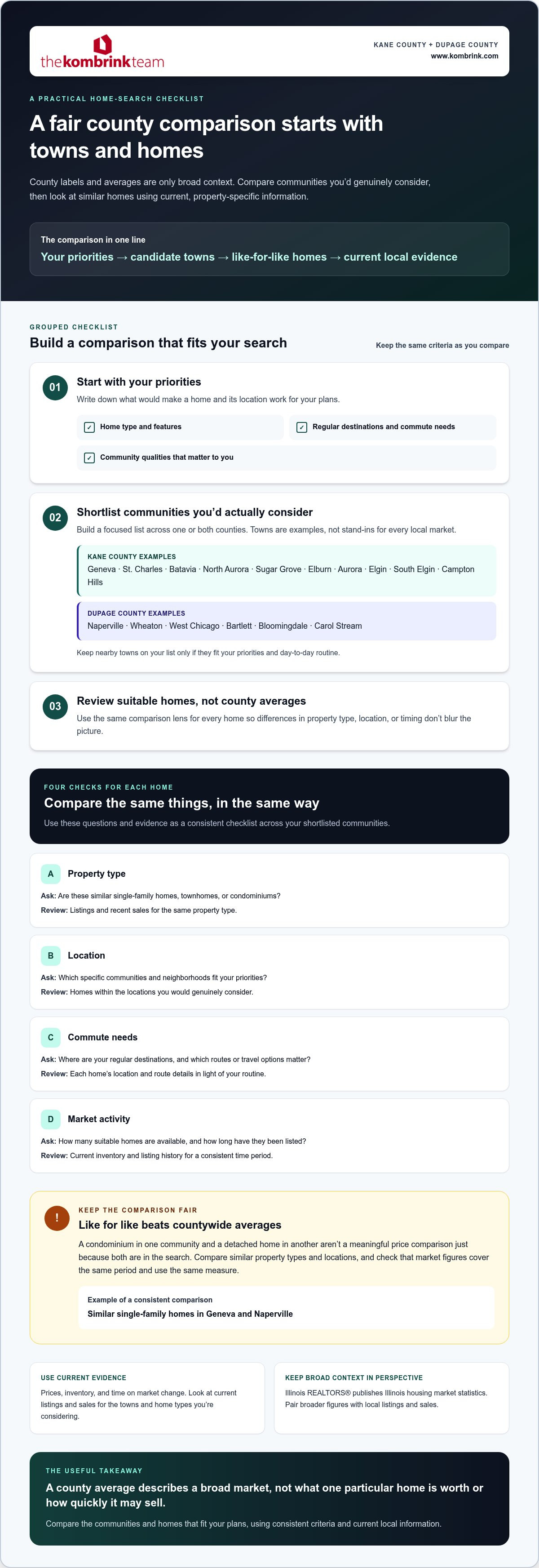
A useful comparison starts with the home you want, the places you need to reach, and evidence from similar nearby properties. For Kane county vs DuPage county real estate, compare current options in your candidate communities rather than drawing conclusions from county averages alone. Keep your criteria consistent as you compare, so differences in property type or location don’t distort the picture.
| What to compare | Questions to ask | Evidence to review |
|---|---|---|
| Property type | Are you comparing similar single-family homes, townhomes, or condominiums? | Listings and recent sales for the same property type |
| Location | Which specific communities and neighborhoods fit your priorities? | Homes within the locations you would genuinely consider |
| Commute needs | Where are your regular destinations, and what routes or travel options matter? | Location and route details for each home, assessed for your routine |
| Market activity | How many suitable homes are available, and how long have they been listed? | Current inventory and listing history for a consistent time period |
What should buyers compare beyond county averages?
Start with like-for-like homes. A condominium in one community and a detached home in another won’t provide a meaningful price comparison simply because both are in the same search. Compare similar property types and locations, then check that market figures cover the same period and use the same measure. For example, compare single-family homes with similar features in Geneva and Naperville, rather than treating all listings in either county as equivalent.
Prices, inventory, and time on market change, so use current local evidence. Illinois REALTORS® publishes Illinois housing market statistics for broader context; pair those figures with listings and sales for the towns and home types you’re considering.
A county average describes a broad market, not what one particular home is worth or how quickly it may sell. The Kombrink Team offers buyer representation and real estate market reports to help you compare local options. You can talk through your local home search and identify the details to focus on.
Choose a county by narrowing your search to the right local fit
Instead of deciding on a county first, use a short process to identify where the right home may be. Crossing from Kane County into DuPage County doesn’t automatically mean better value or a better match. The useful comparison is between communities and homes that fit your plans.
- List your priorities. Note the home type you want, the features that matter, your regular destinations, and the community qualities you value.
- Choose candidate towns. Build a focused shortlist across both counties. In Kane County, you might consider Fox Valley communities such as Geneva, St. Charles, Batavia, North Aurora, Sugar Grove, or Elburn. Depending on your preferred location, you could also include Aurora, Elgin, or South Elgin, then compare them with DuPage County options such as Naperville, Wheaton, or West Chicago. Bartlett, Bloomingdale, Carol Stream, and Campton Hills may also be relevant to a wider local search.
- Review suitable homes. Look at current listings that meet your needs, then compare their locations, features, and available market information. Keep nearby towns on the list only if they fit your daily routine and priorities.
This sequence helps prevent a common misstep: treating a county boundary as a shortcut to value. A home’s fit depends on its own characteristics and location, alongside what matters to you. Keep your priorities consistent as you compare, and revise your town shortlist if the available homes don’t match them.
When can local buyer representation help?
A buyer-focused conversation can help clarify which priorities are essential and which communities deserve a closer look. The Kombrink Team provides buyer representation across Northern Illinois, including Kane and DuPage counties. A complimentary home-buyer consultation and reports can help you organize a search that spans more than one area without assuming one county is the right choice for everyone.
If you’re weighing communities across both counties, talk with The Kombrink Team about your home search. A clear discussion of your needs can help you decide which towns and current listings to explore next.
Make your next move with a clear local perspective
Your next step doesn’t have to be choosing a county today. Use what you’ve learned to shape a practical shortlist, then let current homes and your priorities guide the comparison. A focused approach to Kane county vs DuPage county real estate can make it easier to recognize which options deserve a closer look.
The Kombrink Team has served Northern Illinois since 1991. Buyer representation and local market reports can support an informed search across Kane and DuPage counties, whether you’re beginning with Geneva, Batavia, Naperville, Wheaton, DeKalb, or another community. The team also provides free home valuations for homeowners who want a valuation as they consider their next move.
Talk with our team about comparing homes across Kane and DuPage counties Share your priorities with The Kombrink Team to get started on a focused search across the communities that fit your plans.
Frequently Asked Questions
Do county boundaries determine which school district a home is in?
No. County borders and school district boundaries are separate, so a home’s county alone won’t identify its assigned schools. District boundaries may also differ from municipal boundaries. Before making a decision based on school assignment, use the exact property address with the relevant district’s boundary or attendance information, since assignments can vary by address.
Are property taxes higher in Kane County or DuPage County?
There isn’t one answer that applies to every home. For Kane county vs DuPage county real estate, county-level effective-rate estimates provide only broad context, not a specific property’s tax bill. The amount for an individual address can reflect its assessed value, applicable taxing districts, and exemptions. Compare the parcel’s current tax information rather than relying on a county average.
Can I search for homes in both Kane County and DuPage County at the same time?
Yes. You can include communities from both counties in one search, such as Geneva or St. Charles alongside Naperville or Wheaton. This can be useful if your preferred location isn’t settled. As you review results, check each listing’s address and details so you’re comparing homes that actually match your location, property type, and other search criteria.
Is one county always a better real estate investment?
No county is a guaranteed better investment for every buyer. Potential value depends on the specific property, its location and condition, the purchase terms, and your plans for ownership. A broad county trend can’t predict how one home will perform. Compare relevant homes and local market information, and consider your own objectives before making an investment decision.
Disclaimer
This article is provided for general informational purposes only and is not intended as legal, tax, financial, or mortgage advice. Real estate laws, market conditions, rates, and individual circumstances can change. Consult the appropriate licensed professional regarding your specific situation.
Enjoy this blog post? Click here to subscribe for updates
Leave A Comment