

How to Price Your Northern Illinois Home to Sell

Nearly 50% of homes in the Fox Valley sold for above their list price in May 2026, yet many sellers still stay up at night worrying they’ll leave equity on the table. It’s a valid fear. You’ve likely seen conflicting estimates from online valuation tools and wondered how to price a home to sell without it sitting on the market for months. We understand that your home is your largest investment. The anxiety of getting that initial number just right can feel overwhelming when you're balancing market data with your own financial goals.
You deserve a strategy that replaces guesswork with local expertise and a steady hand. This guide will help you master the art and science of home pricing to attract top offers and ensure a seamless sale. We’ll provide a clear framework for setting a competitive price, explain how current Fox Valley trends affect your specific value, and give you the confidence to launch your listing with a strategy built for success. From navigating property tax impacts to understanding the sale-to-list price ratio, you’ll have the insights needed for a smooth transition.
Key Takeaways
- Capitalize on the "First 30 Days" rule to capture peak buyer interest and avoid the stagnation that comes with an inflated initial price.
- Discover how to price a home to sell by utilizing a Comparative Market Analysis (CMA) that looks at recent local sales rather than generic online estimates.
- Navigate the nuances of Geneva and St. Charles micro-markets where school district boundaries and local inventory levels significantly shift value.
- Use strategic "price bracketing" to ensure your home appears in more online searches on major real estate platforms like Zillow.
- Secure a professional Home Valuation Report to transform complex Fox Valley market data into a clear, confident listing strategy.
Table of Contents
- The Critical Window: Why Initial Pricing Dictates Your Success
- Decoding the CMA: How Professionals Evaluate Market Value
- Local Market Dynamics in the Fox Valley Area
- Pricing Psychology: Strategic Tactics to Attract Buyers
- Finalizing Your Strategy: The Professional Advantage
The Critical Window: Why Initial Pricing Dictates Your Success
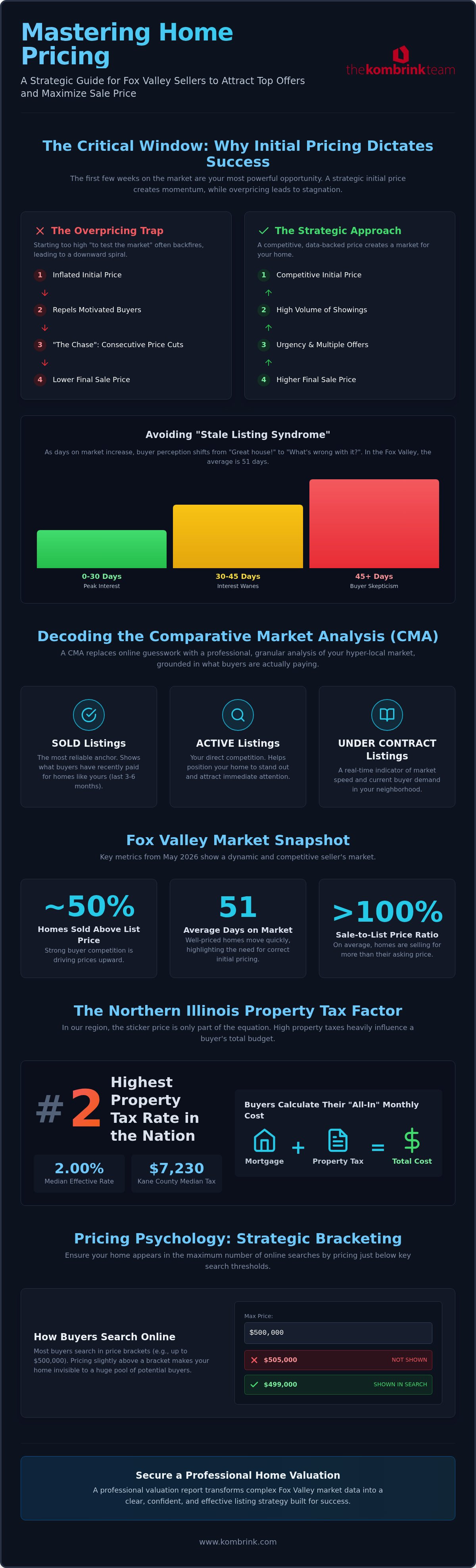
The first few weeks your home is on the market represent your best chance at securing a premium offer. During this "First 30 Days" window, motivated buyers who have been waiting for new inventory will rush to see your property. If you're wondering how to price a home to sell, the answer lies in capturing this initial wave of excitement. Many sellers feel tempted to "test the market" by setting an intentionally high price, assuming they can simply lower it later. This strategy often backfires. Instead of attracting top offers, an inflated price acts as a filter that pushes your most likely buyers toward more realistically priced competitors.
When a home is overpriced, it starts a downward spiral known as "the chase." You end up chasing the market down with consecutive price cuts. By the time the price is right, the initial momentum is gone, and you often settle for a lower final sale price than if you had priced it correctly from day one. A professional real estate appraisal or valuation report provides the objective data needed to avoid these emotional pricing traps. Maintaining a steady hand during this phase ensures you don't let personal attachments cloud the market reality.
The Stale Listing Syndrome
What happens when a home sits on the market too long? In the Fox Valley, where homes sold after an average of 51 days as of May 2026, crossing the 45-day threshold can be risky. Buyers begin to view the property with skepticism. The conversation shifts from "Is this a great house?" to "What is wrong with it?" This psychological barrier makes it much harder to negotiate from a position of strength. A stale listing often requires a significant price drop to overcome buyer doubt, which is exactly the scenario we aim to prevent through accurate initial positioning.
Maximizing Early Momentum
The relationship between price and showing volume is direct and powerful. A well-priced home acts as a magnet, drawing in a high volume of foot traffic during the first week. This surge of interest creates a natural sense of urgency among buyers. When three different families are touring your home on a Saturday afternoon, they feel the competition. This environment is what leads to multiple-offer scenarios and sale-to-list price ratios that exceeded 100% in our local market earlier this year. By setting a competitive price from the start, you aren't just listing your home; you're creating a competitive market for it.
Decoding the CMA: How Professionals Evaluate Market Value
While an online estimate uses a broad algorithm to guess your home’s worth, a Comparative Market Analysis (CMA) provides a granular look at the local Fox Valley streets. It’s the gold standard for understanding how to price a home to sell because it relies on human expertise rather than cold data. We look for "comps," or comparable properties, that have sold within the last three to six months. This timeframe is vital. It reflects the current interest rate environment, which sat around 6.79% for a 30-year fixed mortgage in August 2026, and ensures we aren't using outdated pricing from a different economic climate.
A thorough analysis doesn't just look at what sold. We also examine "Active" listings to see your current competition and "Under Contract" listings to gauge the current market speed. However, "Sold" listings remain the most reliable anchor for your strategy. They represent the reality of what local buyers were actually willing and able to pay. By blending these three data points, we create a pricing strategy that is both aspirational and grounded in market reality.
Adjusting for Local Property Features
Not every upgrade offers the same return on investment. A finished basement in St. Charles might command a higher premium than a similar project in West Chicago due to specific neighborhood demand and school district draws. We meticulously adjust for these nuances, alongside square footage, lot sizes, and curb appeal, to ensure your price reflects your home's unique character. Fair Market Value is the price a willing buyer and seller agree upon in an open market.
The Property Tax Factor in Northern Illinois
Property taxes are a significant part of the pricing conversation in our region. Illinois has the second-highest property tax rate in the nation, with a median effective rate of 2.00% across the state. When a buyer looks at a home in Kane County, where the median property tax is $7,230, they aren't just looking at the sticker price. They are calculating their "all-in" monthly cost.
If you are comparing a listing in Geneva to one in Batavia, even a slight difference in local tax assessments can shift a buyer’s total budget. We help you position your home so the total monthly payment remains attractive to your target audience, even with our state's unique tax landscape. For a more detailed look at your specific neighborhood, you can request one of our Home Valuation Reports to see how these factors align for your property.
Local Market Dynamics in the Fox Valley Area
Real estate isn't just a national headline; it's a collection of street-level stories. In our region, two houses with identical floor plans can have vastly different market values simply because they sit on opposite sides of a school district line. Understanding these micro-markets is the secret to deciding how to price a home to sell with precision. As of mid-2026, the Fox Valley remains a competitive environment. While inventory statewide was 7.7% lower in March 2026 compared to the previous year, the local absorption rate, or the speed at which homes sell, continues to dictate our strategy.
Monitoring the absorption rate helps us determine if we are in a seller’s or buyer’s market. When inventory is low, as it is now, homes often sell faster than new ones arrive. However, with mortgage rates hovering around 6.79% in August 2026, buyers are more selective than they were during the record-low rate years. They aren't just looking for a house; they're looking for a value that justifies the current cost of borrowing. A steady hand is required to balance these two forces without overshooting the mark.
School Districts and Home Values
Top-rated school districts in Geneva and St. Charles act as a powerful anchor for property values. Buyers often pay a significant premium to secure a spot within these specific boundaries. If your home is located just outside a primary school boundary, your pricing strategy must reflect that reality. We leverage local school rankings and community demand to justify your list price, ensuring you don't lose potential buyers who are strictly filtering their search by district codes.
Navigating Local Inventory Cycles
The Northern Illinois climate creates a distinct rhythm for real estate. The "Spring Rush" typically sees a surge of motivated families looking to move before the new school year, which can support a more aggressive pricing floor. Conversely, the "Winter Lull" requires a different approach. During the colder months, inventory drops, but so does the number of active buyers. This guide gives you the blueprint for how to price a home to sell regardless of the month. By aligning your price with these seasonal cycles, you can stand out even when neighborhood inventory fluctuates. Our team’s 30 years of local experience ensures you are never guessing which way the wind is blowing in the Fox Valley market.
Pricing Psychology: Strategic Tactics to Attract Buyers
Have you ever wondered why some homes seem to appear in every search result while others remain hidden? The secret often lies in understanding the digital psychology of modern buyers. When considering how to price a home to sell, you must think like a user browsing on Zillow. Most buyers set their search parameters in round increments, such as "up to $400,000" or "$450,000 to $500,000." If you list your property at $505,000, you are invisible to every buyer who capped their search at half a million dollars. This simple oversight can cost you thousands of potential views in those first few days.
Strategic pricing isn't just about picking a number; it's about signaling value. In our current market, where 49.9% of Fox Valley homes sold for above the list price in May 2026, the initial price acts as a marketing lever. Pricing slightly below the expected appraisal can actually trigger a multiple-offer scenario. This competition often pushes the final sale price higher than a more aggressive starting point would have. It requires a steady hand to trust the process, but the results often speak for themselves in the form of cleaner terms and higher net proceeds.
Mastering the Search Portals
Landing in the most "saved search" notifications requires a strategic approach to whole numbers. While retail stores love "charm pricing" like $499,900 to make a product feel cheaper, real estate is different. Pricing at exactly $500,000 allows your home to show up in two distinct search brackets: those looking from $450,000 to $500,000 and those looking from $500,000 to $550,000. This doubles your initial exposure. By capturing both the "top of the budget" and "bottom of the budget" buyers, you maximize your visibility during the critical first week.
Removing Emotion from the Equation
It's natural to feel that your home is worth more because of the memories made there or the specific amount you need for your next down payment. However, "The Nest Egg Trap" is a common hurdle for many sellers. Buyers don't care what you paid for the house in 2010 or how much you need to net for your move to Florida. They are purely focused on current market value. Trusting a professional Home Valuation Report helps you separate sentimental value from market reality. This objective perspective provides the peace of mind that your strategy is built on facts rather than personal bias, ensuring a smoother path to the closing table.
Finalizing Your Strategy: The Professional Advantage
Setting the right number is only half the battle; defending it is where the real work begins. When you're determining how to price a home to sell, you aren't just trying to attract a buyer. You're also preparing for the bank's appraisal process. If a home in North Aurora sells for a competitive price but the appraiser can't find the data to support that value, the deal can fall apart. This is why a professional Home Valuation Report is your most powerful tool. It provides a defensible, data-backed foundation that stands up to scrutiny from lenders and buyers alike. By grounding your price in reality, you protect your equity and ensure a smoother path to the closing table.
The Kombrink Team has been a steady hand in the Fox Valley area since 1991. As a family-owned team under One Source Realty, we blend over 30 years of localized experience with modern technology to ensure your listing strategy is unparalleled. While online tools provide a starting point, they lack the "boots-on-the-ground" insight that identifies why one block in South Elgin commands a premium over another. We look beyond the numbers to see the lifestyle value of your property, ensuring every upgrade and unique feature is accounted for in your final strategy.
The Role of Professional Market Reports
Our team utilizes real-time Real Estate Market Reports to pivot your strategy as the market shifts. These specialized reports for Geneva, Batavia, and St. Charles offer an insider's perspective that automated values simply can't match. An algorithm doesn't know if a nearby sale was a distressed property or if a new local development is about to drive up demand. We provide a methodical, thorough assessment that makes your price defensible during the appraisal process. This transparency builds trust with buyers and gives you the confidence to hold firm during negotiations.
Taking the Next Step with Confidence
Once you understand how to price a home to sell, you can transition from the math of the market to the presentation of your home. A clear price allows you to focus on becoming "market-ready" through professional staging and high-end photography. This holistic approach ensures that when your home hits the MLS, it isn't just another listing; it’s a compelling opportunity. We are here to lead you through every nuance of this process, from the first valuation to the final signature. Ready to see what your home is worth? Get your expert Home Valuation Report here and take the first step toward a successful sale.
Launch Your Listing with Confidence
Mastering the art of home pricing is the difference between a listing that lingers and one that leads to a successful closing. By capturing the critical first 30 days of engagement and utilizing strategic search brackets, you position your property for maximum visibility. We've explored how localized data and the psychology of pricing can transform your selling experience from stressful to seamless. Understanding how to price a home to sell requires a balance of market math and neighborhood nuance that only comes with deep-rooted experience.
Since 1991, our family-owned team has provided a steady hand for homeowners across Geneva, Batavia, and St. Charles. We offer specialized market reports that go far beyond generic online estimates, providing you with the clarity you need to move forward. You don't have to navigate this significant life transition alone. Our seasoned mentors are ready to guide you toward a premium offer and a stress-free experience.
Get Your Professional Home Valuation Report from The Kombrink Team
Your next chapter is waiting. We are here to ensure you start it on the strongest possible footing.
Frequently Asked Questions
Is it better to price my home high and lower it later?
It's generally better to price your home accurately from the start rather than aiming high with the intent to reduce it later. Pricing too high often leads to "stale listing syndrome," where buyers become skeptical after the property sits on the market for more than 45 days. You lose the vital momentum of the first two weeks, which is when the most motivated buyers are active and ready to make offers.
How much does the school district affect my home’s price in the Fox Valley?
School district boundaries create distinct micro-markets that heavily influence property values in our region. In towns like Geneva and St. Charles, being within certain district lines can command a significant price premium compared to identical homes just across the border. Buyers often filter their searches strictly by these districts, meaning your price must reflect the specific educational demand of your street to remain competitive.
Should I price my home exactly at the Zestimate?
Pricing exactly at an online estimate like a Zestimate is risky because these tools rely on broad algorithms rather than specific local nuances. They often miss recent upgrades or the unique curb appeal of a Fox Valley property. A professional assessment is a much more reliable way to determine how to price a home to sell, as it accounts for current buyer sentiment and actual property condition.
What is the most common mistake people make when pricing their home?
The most common mistake is letting personal attachment or future financial needs dictate the list price. Sellers often fall into "The Nest Egg Trap," where they price based on what they paid years ago or how much they need for their next down payment. Buyers are only concerned with current market value, so it's essential to remain objective and trust local data over sentimental bias for a smooth sale.
How do property taxes in Kane County impact my asking price?
Property taxes in Kane County directly impact a buyer's monthly budget, which in turn influences what they can afford to pay for your home. Since Illinois has the second-highest property tax rate in the nation, with a median effective rate of 2.00%, buyers are very sensitive to these costs. In Kane County, where the median property tax is $7,230, we must ensure your price stays attractive relative to the total monthly payment.
Can I price my home higher if I have a larger lot than my neighbors?
You can often justify a higher price for a larger lot, but the increase isn't always a dollar-for-dollar match. We use a Comparative Market Analysis to see how much local buyers are actually paying for extra acreage in your specific neighborhood. While a larger lot adds value and appeal, the final price must still align with what recently sold properties of similar size and quality are fetching in the area.
How often should I adjust my price if I don’t get any offers?
If you haven't received an offer after 10 to 15 showings or roughly three weeks on the market, it's time to re-evaluate your strategy. This timeline allows for enough market testing while preventing the listing from becoming stagnant. A quick, strategic adjustment shows buyers you are motivated and helps your home land back at the top of their search results with a fresh perspective.
Does the time of year really change how I should price my home in Illinois?
Seasonal cycles in Chicagoland play a significant role in how to price a home to sell effectively. The "Spring Rush" typically brings more competition but also a larger pool of motivated families, which can support a more aggressive pricing floor. During the winter months, inventory levels are lower, which can work in your favor if your home is positioned as a standout, well-maintained option for year-round searchers.
Disclaimer
This article is provided for general informational purposes only and is not intended as legal, tax, financial, or mortgage advice. Real estate laws, market conditions, rates, and individual circumstances can change. Consult the appropriate licensed professional regarding your specific situation.
Enjoy this blog post? Click here to subscribe for updates
Leave A Comment